Fausta's blog

Faustam fortuna adiuvat
The official blog of Fausta's Blog Talk Radio show.

Sunday, June 22, 2008

The real story, and Associated Press' story

The real story: Chavez is nationalizing the mining industry. Let's look at three headlines:

CNN correctly states Venezuela 'taking control' of mines".

The IHT couches the seizure of property by citing the environment minister: Environment minister says Venezuela is asserting national interest in mining sector. At least they have the delicacy of attributing the propaganda to a Venezuelan government official.

But leave it to Associated Press to put a real gloss on the pig's lipstick: Venezuela puts nation's interests first in mining. They don't need to attribute the propaganda to any environment minister; they can do a propaganda job on their own, thanks. Those are the folks that, if you quote them, will have you go through the toll booth.

Good luck on that, AP.

Related
AP's confused.

Digg!

Share on Facebook

Labels: , , , , ,

Wednesday, June 18, 2008

Castro's new video

The latest video showing Castro with Chavez and Raul, with Castro wearing the same jogging suit he's been wearing for a couple of years now,


Hugo says that they talked about the food and energy crisis, but the footage has no sound. It was released after Granma forgot to post Castro's byline for a couple of weeks.

The video was supposedly taken during Hugo's latest visit two days ago. Reuters makes the understatement of the day,
Castro's long absence from the public eye had fed rumors that his health was failing.
The mummy lives.

Digg!

Share on Facebook

Labels: , , ,

Tuesday, June 03, 2008

Chavez Decree Tightens Hold on Intelligence

Having lost last December's referendum - by which he wanted absolute powers - Chavez is resorting to consolidating his power through decrees, all in the name of defeating "the empire", i.e. the United States.

In today's NYT, Simon Romero reports that Chavez Decree Tightens Hold on Intelligence (h/t Siggy)
President Hugo Chavez has used his decree powers to carry out a major overhaul of this country's intelligence agencies, provoking a fierce backlash here from human rights groups and legal scholars who say the measures will force citizens to inform on one another to avoid prison terms.

Under the new intelligence law, which took effect last week, Venezuela's two main intelligence services, the DISIP secret police and the DIM military intelligence agency, will be replaced with new agencies, the General Intelligence Office and General Counterintelligence Office, under the control of Mr. Chavez.

The new law requires people in the country to comply with requests to assist the agencies, secret police or community activist groups loyal to Mr. Chavez. Refusal can result in prison terms of two to four years for most people and four to six years for government employees.
Hugo's new decree is a carbon copy of what the Castro regime has used for oppressing its people for the past half century:
But the new law may also point to the influence of Cuba, Venezuela’s top ally, on intelligence policies. For instance, the use of community-monitoring groups to assist in gathering intelligence resembles Cuba's use of neighborhood Committees for the Defense of the Revolution to report on antigovernment behavior.
One more stepping stone towards Cubazuela.

The BBC reports that
The law allows security forces to gather evidence through surveillance methods such as wiretapping without obtaining a court order, and authorities can withhold evidence from defence lawyers if it is considered to be in the interest of national security.
Of course the Chavistas hasten to reassure the naive that
On Monday, however, [Interior Minister] Mr. Rodríguez Chacín softened his tone, saying the law would not lead to political intimidation or restrict freedom of expression.
The law is so restrictive and volatile that Chavez didn't risk pushing it through the National Assembly, , because
justice officials, including judges, are required to actively collaborate with the intelligence services rather than serve as a check on them.
Now that Chavez has changed the laws yet again, is a Venezuelan Soviet-style Check enforcement in the works next?

UPDATE
Venezuela News and Views: Chavez Decree Tightens Hold on Intelligence
Because make no mistake: this new decree law is worse than the Patriot Act of the US. If I bring up this last remark it is because the Bush administration Patriot Act is perhaps its most controversial legal action, the one that has damaged the most its popularity over the years. Not for me to discuss the virtues and sins of the Patriot Act here: I want to limit myself to note that the Patriot Act was lengthily discussed, had to be voted and exists in a country where considerable safeguards exists. Not to mention that September 11 did take place and that the US is truly under constant terrorist threat. Maybe there were better ways to enhance US security but the Patriot Act is still under the constant monitoring of an independent judicial system and a strong press, thus many abuses have been corrected.

None of this would hold true for Venezuela as the new decree law goes into practice.
In other Hugo news, Hugo Chavez Goes After the Jews Again

And at IBD,
Internal Spying Begins In Venezuela
Intelligence organs will now be split into four groups, to ensure that they operate in a snitching climate of internal fear, unable to unite against him. His interior minister, Ramon Rodriguez Chacin, who on TV last December told FARC terrorists "we are with you," is as thuggish as he appears. He even bears a physical resemblance to Lavrenty Beria, Josef Stalin's feared secret police chief.

Digg!

Share on Facebook

Labels: , , ,

Friday, November 30, 2007

The "Blame the CIA Game" is back!

For a while there it had died (no doubt because of the CIA's clear mishandling of a number of things), but hey! A good game never dies; it just keeps turning up like a bad penny.
(emphasis added to all items)

In Cuba:
Via Babalu, the Cuban government bulldozed a church in the town of El Salado
Fue destruido con un Buldózer utilizado por la policía, el local de la Iglesia Evangélica Reforma Apostólica, en la ciudad de Santiago de Cuba, nos informaba por teléfono desde la oriental ciudad, Juan Ramón Rivero Despaigne, activista de los derechos humanos.
"La iglesia se encuentra ubicada en las calles Nico, #3, en el pueblo El Salado. Todos sus miembros son acusados por el Gobierno de agentes de la CIA. El pastor Alain Toledano sigue celebrando los cultos en el lugar en donde fue destruida su iglesia", concluyó Rivero Despaigne.

(my translation:)
The police bulldozed the locale used as a church by the Reform Apostolic Evangelical Church in the city of Santiago de Cuba, we are told by phone by Juan Ramon Rivero Despaigne, human rights activist.

The church is located at Streets # 3 and Nicon in the town of El Salado. The [Cuban] government is acussing all the members of the church of being CIA agents. Pastor Alain Toledano continues to celebrate worship services at the location where the church was torn down, Rivera Despaigne reports.
In Venezuela:
Simon Romero reports that Chavez came up with a fake CIA memo, which his cronies were too cheap to find someone to translate into English in order to give it a whiff of authenticity:
Mr. Chavez and senior officials here have exhibited increasingly erratic behavior. Mr. Chavez has lashed out at leaders in Colombia and Spain and asked for an investigation into whether CNN was seeking to incite an assassination attempt against him.

Reports of such plots are not in short supply here. The main state television network broadcast coverage this week of a memorandum in Spanish that it claimed had been written by the C.I.A. in which destabilization plans against Mr. Chavez were laid out. American involvement in Venezuelan politics remains a particularly delicate issue here, after the Bush administration tacitly supported a coup in 2002 that briefly ousted Mr. Chavez.

"We reject and are disappointed in the Venezuelan government's allegations that the United States is involved in any type of conspiracy to affect the outcome of the constitutional referendum," Benjamin Ziff, a spokesman for the United States Embassy here, said in a statement.

A C.I.A. spokesman called the document "a fake," while analysts, including investigators who had previously uncovered financing of Venezuelan opposition groups by the United States government, expressed doubts about the authenticity of the memo.

"I find the document quite suspect," said Jeremy Bigwood, an independent researcher in Washington. "There’s not an original version in English, and the timing of its release is strange."
One of the surest signs of a tyrant is his eagerness to play the "Blame the CIA Game". When that fails, blame the White House (and of course, blame Bush).

More on Venezuela's countdown to tyranny later today.
Digg!

Share on Facebook

Labels: , , ,

Saturday, October 20, 2007

Che's dead & his monument's shot

Via Maria,

Glass Monument to Che in Venezuela Shot

CARACAS, Venezuela (AP) - A glass monument to revolutionary icon Ernesto "Che" Guevara was shot up and destroyed less than two weeks after it was unveiled by Venezuelan President Hugo Chavez's government.
Images of the 8-foot-tall glass plate bearing Guevara's image, now toppled and shattered, were shown Friday on state television, which said the entire country "repudiated" the vandalism.

The monument on an Andean mountain highway near the city of Merida was unveiled Oct. 8 by Vice President Jorge Rodriguez and Cuba's ambassador to Venezuela to mark the 40th anniversary of Guevara's death.

Will the locals turn in whoever did it? I doubt it. Notice who inagurated the monument.

Che gets a bullet between the eyes.
Digg!

Share on Facebook

Labels: , , ,

Friday, September 28, 2007

Ahmadinejad goes to Bolivia and Venezuela; Spacey goes to Venezuela and Cuba

Continuing his triumphal grand tour, after leaving the US and being celebrated by fellational journalists and others, 'Jad went to Bolivia.

Ahmadinejad bolsters Iranian ties with Bolivia and Nicaragua. I have no idea why the IHT headline mentions Nicaragua and not Venezuela, but here's the text of the article (emphasis added):
On a trip to strengthen ties with leftists in Latin America and roll back U.S. influence, the Iranian president, Mahmoud Ahmadinejad, has pledged to invest $1 billion in Bolivia and reaffirmed relations with the Venezuelan president with a declaration that "no one can defeat us."
Promises, promises.

'Jad and Evo go back a long time:


But the promises don't come for free:
The investment in Bolivia, to be made over the next five years, would help the country tap its vast natural gas reserves, extract minerals, generate more electricity and finance agricultural and construction projects.
After La Paz, 'Jad flew up to Caracas, where the love flowed:

Chavez greeted the Iranian leader warmly on a red carpet in front of the presidential palace, where they both stood before microphones and let loose with rhetoric challenging Washington.
The BBC states, "The Iranian and Venezuelan leaders see themselves as brothers, with similar political aims."

You know things are screwed up in Venezuela that pro-democracy students are asking Ahmadinejad to serve as intermediary with Chavez so Hugo will grant them the right to ask questions regarding Venezuelan-Iranian relations.
---------------------------------------------------------

In other Latin American celebrity travel news, Actor Kevin Spacey met with Chavez looking for oil money to produce movies, since Hugo Chavez Funds State-Run Film Studio and already gave Danny Glover a few million $$$.

I wonder if Hugo and Kevin were pondering another sequel to The Karate Kid, but maybe it was just a regular dinner-and-a-movie kind of date:
Neither Spacey _ who has won Academy Awards for roles in "The Usual Suspects" and "American Beauty" _ nor Chavez spoke to the press after the nearly three-hour encounter in the presidential palace in Caracas. They shook hands warmly on the red carpet as Spacey left after a dinner with Chavez.
We'll never know for sure.

The AP story claims that "Details were not released about the rest of Spacey's itinerary." Maybe the AP reporter should have spent some time watching Venezuela's government-controlled TV newscasts, because in this video (via Jeremayakovka) the reporter (in Spanish) says that after Caracas Kevin was heading to Cuba.

Chalk it up to Associated Press Deficit Disorder, because Kevin indeed went to Cuba after leaving Venezuela.

Marc Masferrer links to the article, El actor estadounidense Kevin Spacey se pasea de incógnito en Cuba (American Actor Kevin Spacey Travels Incognito Through Cuba).

Other recent visitors to Cuba listed in the article include Michael Moore, Benicio del Toro, Steven Soderberg, Sean Penn, Joseph and Ralph Fiennes, Gael García Bernal and Fernando Trueba.

I don't believe any of them asked about Martha Beatriz Roque, Elizardo Sanchez, or much anyone else who is not a celebrity.

Update: GM follows up.
---------------------------------------------------------

Update 2:
Totten's turn;


Digg

Share on Facebook

Labels: , , , , , , ,

Friday, September 21, 2007

It's Friday, so Castro's not yet dead

Sure as rain, every Friday there's a rumor or denial concerning the not-dead-yet dictator of the island-prison:
BOOK: CASTRO'S SON SAYS DAD DYING; BUT CUBAN LEADER DETERMINED TO OUTLIVE BUSH PRESIDENCY

Tell ya what: "Castro" is determined to outlive all American presidencies because he is a dictator.

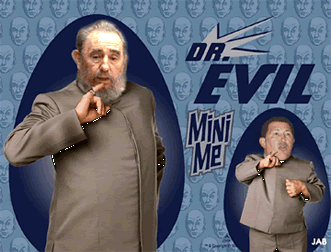
And of course, Fidel's Mini-Me pipes in: Cuba's Castro nearly died but is OK now: Chavez

UPDATE: Oh, look, he's even wearing wearing the Adidas jogging suit, and looking healthy again. The BBC has a video report here.

Prior jogging-suit photo-ops here and here

Digg!

Share on Facebook

Labels: , ,

Monday, September 17, 2007

Venezuela: And now it's the private schools

UPDATED

When Hugo Chavez declared a socialist republic las January, I predicted that Venezuela's private economy will disappear as we know it.

Chavez's latest target? Private schools (h/t Pamela):
Venezuela's Chavez Warns Private Schools (emphasis added)

Venezuelan President Hugo Chavez threatened on Monday to close or take over any private school that refuses to submit to the oversight of his socialist government as it develops a new curriculum and textbooks.
"Society cannot allow the private sector to do whatever it wants," said Chavez, speaking on the first day of classes.

All schools, public and private, must admit state inspectors and submit to the government's new educational system, or be closed and nationalized, with the state taking responsibility for the education of their children, Chavez said.

Those who can leave, are leaving:
Teachers and academics may see the measure as an attempt to politicize the classroom, speeding up a brain drain that has been underway for years as educated, skilled workers move abroad to escape Chavez's "Bolivarian" revolution, said Ercilia Vasquez, director of the school of education at the Universidad Catolica Andres Bello in Caracas.
Of course, there's a new curriculum to indoctrinate the "new citizens", while
the education minister said the aim is to develop "critical thinking," not to impose a single way of thought.
And who is the education minister, you ask?

Hugo's brother, Adan Chavez.


On related news, A colombo-americana's perspective has a report on religious freedom in Venezuela.

Update, Tuesday 19 September:
If you need it spelled out, here's why private schools will be taken over,
"If they attack us because we're indoctrinating, well yes, we're doing it, because those capitalist ideas that our young people have — and that have done so much damage to our people — must be eliminated," Campos said.
Any questions?

The salami tactics of Hugo Chavez
This is a serious slice, and there is a lot here: the submission of the private to the public, a leader speaking for "society," a new (re-)educational system, propaganda, threats of nationalization and state control, the concept of a "new citizen," nepotism. This could be 1984. There may not yet be any killing fields — none that we know of — but the rest is beginning to look a lot like the tyrannies, the totalitarian tyrannies, of the last century. Pol Pot, meet Hugo Chavez.
(h/t Captain Ed)
Digg!

Share on Facebook

Labels: , , ,

Wednesday, September 12, 2007

'Fidel' is now a truther; Putin dissolved the government

I was about to post on this earlier this morning when my internet connection was rudely interrupted:

Fidel Castro says U.S. fooled world over 9/11
Ailing Cuban leader Fidel Castro said the U.S. government misinformed Americans and the world about 9/11, echoing conspiracy theories about the terror attacks against the United States six years ago.

In an essay read by a Cuban television presenter on Tuesday night, Castro said the Pentagon was hit by a rocket, not a plane, because no traces were found of its passengers.
"Fidel" or his amanuensis have now officially joined the Truthers.

In other "Fidel" news, the Cuban Culture Minister says Castro's not dying.

Which is probably true.

Moving right along,
Vlad is taking time off from his modeling job to dissolve the government and name a new prime minister,
Russia President Vladimir Putin has dismissed his entire cabinet and replaced his prime minister in a bid to pave the way for his successor. On Wednesday, Prime Minister Mikhail Fradkov submitted his resignation, and the speaker of the State Duma later announced he was being replaced by the relatively unknown Victor Zubkov, head of the country's money-laundering watchdog agency.

He probably won't stay there for long.

Though it's no safe bet, many analysts have their money on Putin ally and KGB veteran Sergei Ivanov to be voted in as the new president in the March 2008 election. It is probable that Putin will put him in the place of Zubkov at the last minute, since Russian presidents usually come from the post of prime minister, as Putin did himself to succeed Boris Yeltsin.
UpdateZubkov seems to want to run for president next year.

Those of us old enough to remember the Cold War days find no joy in reading that Vlad's also embarking on a new arms race.

What does this all mean? Pajamas Media has an article by Sean Guillory that sheds light on the subject.

But don't be surprised if the "dad of all bombs" turns up at a Caribbean nation near you, along with the Russian subs.

Digg!

Share on Facebook

Labels: , , , , ,

Wednesday, August 29, 2007

Cubazuela today: The "seemingly invincible Clinton-Obama", and Buckely on Hugo

"Fidel" has written another article for Granma, and he damns "the seemingly invincible ticket of Clinton-Obama" for asking for a democratic government in Cuba. However, he heaps praise on Jimmy Carter, that friend of Hugo.

Apart from the usual stuff one expects from the invisible dictator who writes newspaper articles from an undisclosed location, "Castro" also mentions that he and Che used to play golf together and that Che had caddied in his younger days.

Who'd have thun it!
-------------------------------------------------------

William F.Buckley notices that Hugo Chavez is an Annoyance (what took you so long, Bill?)
The thing about Hugo Chavez is that he is not crazy. He just acts crazy.

On the foreign-policy front, he endears himself, or seeks to do so, to every tyrant on Earth. He went to Iran and intended to visit North Korea, but there, Venezuela's National Assembly drew the line. He is abject in his praise of Fidel Castro, and unequivocal in his hatred of American institutions.

It is a pity; but we need to remind ourselves that every now and then democracy simply spits in one's face. The people who voted in 1933 for Adolf Hitler were driven by that dangerous temptation.

In Latin America, the demagogue has a great natural advantage. The reason for this is that the United States represents, to the angry Latin American voter, the hothouse of hateful institutions. Hugo Chavez is head of a country of 27 million people. They are mostly poor. And with poverty there often comes pain from observing those who do not share in it.
We all know where this is leading them.

Expect it to get worse for a long time.

Labels: , , , , ,

Wednesday, July 25, 2007

Remember those Cuban doctors Fidel sent to Venezuela?

Via Mike's America,
Growing numbers of Cuban doctors sent overseas to work are defecting to the USA
A large number of the defectors have fled from Venezuela, which has received some 14 000 Cuban medical professionals, more than the rest of the world combined. Currently, dozens have sought refuge in neighbouring Colombia, often living in precarious conditions, while they await permission to enter the USA.

Andres paid a price to get to Colombia. He and his wife had been assigned to the city of Punto Fijo on the northwestern coast of Venezuela, not far from the border. Their escape went smoothly until they reached the frontier, where Venezuelan guards refused to permit them to cross because the visas on their passports were valid only for travel within Venezuela. Only after Andres bribed the agents with nearly all their possessions did the guards let them leave Venezuela. “We gave them all the money we had, cellular phones, watches, and they let us cross”, he said. “We were in Colombia and we had reached freedom. We felt free.”

Andres and his wife were fortunate because not all defecting Cubans get across the border but are, instead, arrested and shipped back home. Once across the border, however, Andres and his wife found themselves stranded in north east Colombia's harsh Guajira desert without contacts or money to continue travel. Eventually, however, they were given a lift by truckers, who carried them to the capital, Bogota.

In Bogota, Andres has lived with two other defectors in an unused storage room provided by a church group. They have also received assistance from the UN High Commission for Refugees. But, as they wait for their US visas, many of the Cubans are fearful because of their uncertain legal status in Colombia, whose government has given few of them refugee status.
The working conditions are those of slave labor:
Several Cuban defectors interviewed in Bogota said that they fled not only because of oppression in their own nation, but also because of unreasonably poor and demanding work conditions in Venezuela. Andres said that he could not stand the conditions in Venezuela, where he lived in a crowded house with a leaky straw roof which he shared with fifteen other Cuban doctors waiting to be put to work.
...
The doctors also said that in Venezuela, Cuban minders monitored their movements, prohibiting non-work contact with Venezuelans. When not at work, the Cubans were required to be at home after 6 pm. One couple said that after they pointed out some problems with the programme, officials threatened to send them back to Cuba in retaliation.

The Cubans said that the programme they worked in, called “Inside the Barrio”, was also plagued with mismanagement and inefficiency. Although many clinics were severely understaffed, newly-arrived medics sometimes sat for months waiting for assignment to a post, they said, and often conditions in the clinics were rudimentary lacking even basic medicines.
And they're fleeing from Bolivia, too.

Read the article. Earlier this year the WaPo had

You should also bear in mind that Cuba's suffering shortages of healthcare workers because one-fifth of Cuba's health care labor supply - some 14,000 doctors and 6,000 health workers - has been contracted out to work in Venezuela. In return for these medical services, Cuba receives 90,000 barrels of discounted oil per day.

Chew on that the next time you read/hear about the charismatic-leader-helping-the-poor-offering-free-health-care-education-adult-literacy-and-job-training-initiatives-that-help-millions-of-Venezuelans/Cubans/Bolivians, and every time you hear about the excellent Cuban healthcare and other myths.

Too bad the folks who have been playing SICKO at the downtown movie theater for the past 5 weeks, and the folks who watch the movie don't care much about reality.

Update
Slide show: Cuban Healthcare in Decline (h/t The Real Cuba).

Update, Friday 27 July
More on the Sicko Propanganda.

Digg!

Share on Facebook

Labels: , , , , ,

Monday, June 25, 2007

One-Way U.S. Trade For Ecuador?, asks IBD

Ecuador's president, Rafael Correa, who wants to dissolve his country's Congress by an assembly with powers to rewrite the volatile nation's constitution, a la Hugo, is knocking at our door asking for free trade:
Presidents Rafael Correa of Ecuador and Evo Morales of Bolivia, are both running notoriously anti-American regimes. They have blasted the U.S. as a capitalist oppressor, and said their whole national mission is to slip its imperialist shackles. Needless to say, they've been no friend to the U.S. in the United Nations. Worse yet, they've forged alliances with some of America's worst enemies, like Iran and Cuba. They've also grown increasingly slack and obstructive in even fighting the drug war that plagues the entire Andean region. Morales has increased coca production by 8%, keeping the street price of cocaine steady even as Colombia's production falls 9%. Ecuador has emerged as a major drug transshipment point and money laundering center - something that is evident by its well-developed illegal immigrant smuggling routes to the U.S., which are the region's best. Ecuador has announced "irrevocably" that it will shut down a tiny U.S. military base at Manta port that tracks drug planes, in order to kick out the U.S. imperialists.

But in exchange for fighting the war on drugs, they've both been recipients of large amounts of U.S. aid in 2006 - $120 million in Bolivia's case and $500 million in Ecuador's. Along with this aid, which is both humanitarian and technical, they both have preferential "ATPDEA" trading privileges to sell their goods duty-free in the U.S. without having to reciprocate the favor to American firms.

With a setup like that, they can, in practical terms, reject and obstruct the idea of real free trade, which would ask them to open their markets to U.S. competition, as long as they retain their current trade privileges. Thus, America's generosity to them has provided a platform for them to condemn real free trade with impunity. But under the radar, they feverishly want a continuation of these one-way US trading privileges, which is why they're suddenly telling America they never really meant it about the 'imperialismo' charges and all that as the expiration beckons.
Investor's Business Daily has more:
Foreign Relations: Should the U.S. offer preferential trade privileges to hostile anti-American regimes that view them as cheap handouts? Offering nothing in return, Ecuador thinks so. We are less sure
The U.S. doesn't ask much from Ecuador. Sandwiched between Colombia and Peru, Ecuador has only provided a tiny "forward operating base" at the port of Manta, with 300 U.S. troops conducting aerial surveillance to keep Colombia's FARC Marxist narcoterrorists from bringing war to Ecuador as they have to their own country.

Instead of helping on that front, Ecuador now vows to shut down the Manta base and let the skies there go unpatrolled.

The Manta shutdown ends any rationale for APTDEA. So does Correa's refusal to recognize the FARC as a terrorist organization or to chase its operatives from Ecuadorean soil.

Worse, Ecuador has harassed Colombia with lawsuits as it tries to eradicate coca fields, making Colombia's war that much harder.
Read both.

In other, "Gimme, gimme!" news, Castro Says U.S. Must Change Its Cuba Policy `Unilaterally'.
But, is he still wearing his jogging suit?

Digg!

Share on Facebook

Labels: , , , , , , , , ,

Wednesday, June 13, 2007

Jogging suit photo-ops continue

While paying lip service to the environment Hugo's doing his best to enlarge his carbon footprint, and the jogging suit photo-ops continue:

Chavez pays 'surprise' Cuba visit
Mr Chavez has visited his friend and ally several times since his illness
Venezuelan President Hugo Chavez has made a surprise visit to Cuba at the invitation of its convalescing leader, Fidel Castro, Cuban state TV reports.
He was greeted at the airport by Vice-President Carlos Lage and Foreign Minister Felipe Perez Roque.

Mr Chavez is expected to meet Mr Castro and his younger brother Raul, who has been acting president since he underwent intestinal surgery in July.

The visit is Mr Chavez's sixth since Fidel Castro fell ill.

The 80-year-old Cuban leader has been recovering at an undisclosed location.
Of course he is.

He and Hugo even discussed energy issues and a regional trade pact during an emotional visit. Anita Snow says so.

Anita's today's winner of the "No Sh*t, Sherlock" Award for Obvious Journalist Statements:
Castro a Key Influence for Chavez

Here we have the only two self-declared Communist rulers in Latin America, Hugo's been Fidel's Mini-Me for years now, and it's taken her this long to realize it.

But then, she has to pimp pump up the pair so Hugo will grant her exclusive interviews:
Chavez, 52, spoke fondly of his friend during an exclusive interview with The Associated Press on Saturday. He brought up memories of their many conversations, recalled greeting crowds of supporters together in Venezuela and also talked about Castro while condemning as unjust the execution of Iraqi leader Saddam Hussein.
As is customary with her, here comes the excellent Cuban healthcare system obligatory soundbitetm
"In Cuba there is no child that isn't in school, no sick person who isn't tended to," Chavez said.
Unless the child's pulled away from school doing mandatory service in el campo, while the sick are tended in the customary way:


All the same, Hugo took her for a ride:
During the four-hour drive, Chavez abruptly broke away from his motorcade at one point, saying he wanted a glimpse of the Apure River swollen by rains - "a magic river," he called it.
That's the kind of reporting Associated Press Deficit Disorder gets you.

Digg!
Share on Facebook

Labels: , , , , , ,

Tuesday, June 12, 2007

The article on Cuba you must read:

Via Albert, A Cuban death rehearsal
With Fidel Castro apparently on the verge of death, I returned to Cuba to visit old friends. Little has changed over recent years and life for most Cubans remains harsh. Yet western visitors continue to romanticise the place
Bella Thomas is intimately familiar with Cuba:
Between 1996 and 1999, I lived periodically in Havana with a gay Spanish diplomat, a close friend who had once, maybe not entirely jokingly, suggested that we marry but maintain our separate ménages. I was too square for that, but when he was posted to Cuba I went to stay with him. Cuba was reputedly not an easy place for homosexuals. I was interested in the country, and I could write about it.

And so for a while I became a pretend prometida of the Spanish cultural attaché. Eventually, many of those we knew—and didn't know—in Havana, seeing my friend's rather open homosexuality, began to suspect that I was a spy, that I was from the CIA (which Cubans pronounce "seer"), or MI5.
As I have mentioned before in this blog, the Castro regime has a history of persecuting gays, hence her need to pose as a "beard".

During the late 1990s there much talk about regime change, which came to nothing,
What observers at this time most underestimated was the power of the regime's nationalist rhetoric and Castro's strategic skill. Unlike in eastern Europe, where nationalism helped to erode communism, Cuban nationalism has shored up the regime. Castro was always a nationalist in communist clothing, and, throughout the 1990s, the communist references in his speeches were gradually replaced by nationalist ones.

The continuing hostilities with the US have played into Castro's hands. It was as an embattled nationalist leader of a small island, standing up to an aggressive, neighbouring superpower, that Castro preserved his revolutionary credentials most effectively.
The UN crowd is still buying into that.
The shortcomings of life under his regime were, he argued, attributable mainly to the US embargo. Many swallowed the argument.
Many still do.
He knew, too, how to capitalise on the latent anti-Americanism in Latin America, Europe and Canada to give his struggle more universal appeal.

In fact, the regime seems to act with zeal to ensure that the embargo continues. When it looks as if the US government might consider ending it, some heavy-handed Cuban act ensues that the status quo prevails. In 1996, when Clinton was keen to initiate rapprochement, the regime shot down two US planes manned by members of a Cuban exile group rescuing those escaping the island on rafts. When, in 2003, an influential cross-party lobby in the US seemed set to dismantle the embargo, the Cuban government promptly incarcerated 75 prisoners of conscience and executed three men who hijacked a tugboat with a view to getting to Miami.
Castro created the textbook for Latin American tyrant wanna-bees.

This is a most insightful article, and a must-read to all who are interested in learning about Cuba. I highly recommend it.

Labels: , , ,

Thursday, May 17, 2007

Venezuela on the front page, again

I must admit that I haven't been posting much about Venezuela because of personal reasons.

I blog because I greatly enjoy blogging. I enjoy not only posting at this blog, but also receiving emails, corresponding with readers and bloggers from all over the world, talking to other bloggers over Skype, and meeting with bloggers in person. When my family is out of town I go to New York and meet with other bloggers.

Through blogging I am also able to allow my visitors to participate in my thought process, something this guy realized way before I realized it myself (which is probably why he writes with the name of three dead shrinks. But I digress). And he's correct: a lot of times I figure out my own position on an issue as I write the post.

Obviously I'm not the most insightful of bloggers, but my research is solid and current, and I always welcome more information. As I said, I really enjoy what I'm doing. But some news do get me down.

Since I purposely try to convey a message of cautious optimism in nearly all of my posts, I have become most reluctant to post about Venezuela.

My reluctance, however, is also matched by my desire to continue to convey accurate information on a subject about which I have posted for the past 3 years. It is a subject of national interest, particularly in view of the current seditious leadership in Congress.

The feedback I get from people who are living in Venezuela, or have travelled recently to Venezuela, is uniformly glum. Things are bad with no end in sight. The prospect of another 50-year-long regime like Cuba's is not, by any stretch of the imagination, a good prospect. Make no mistake, the road to perdition is well marked.

This morning I wasn't planning on posting about Venezuela, but as I picked up the newspaper the headline, Farms Are Latest Target In Venezuelan Upheaval, continues to confirm that Venezuela is firmly positioning itself as Cubazuela:
Vicente Lecuna jabs a wall map of his Santa Isabel ranch so angrily that the map crashes to the floor. "I used to produce 10,000 tons of sugar cane a year," says the 67-year-old Venezuelan cattleman. "Now it's zero! Zero!" he shouts.

Two years ago, squatters seized about half of Mr. Lecuna's 3,000-acre ranch, setting up a cooperative named "Re-Founding the Fatherland." Far from being evicted, the squatters got loans and tractors from the government of President Hugo Chávez. They then uprooted the sugar cane and decided to try their hand at growing plantains.
Mind you, this is at a time where cane-sugar derived ethanol is increasingly becoming a resource for wealth creation.

By ruining the sugar industry, Chavez shot his country in the proverbial foot twice, not just because sugar-cane ethanol is now a commodity, but also because Venezuelan oil production declines as operational oil rigs are down.

But it's all in the name of the revolucion
If the rhetoric smacks of the 1960s, it's because Mr. Chavez dreams of transforming Venezuela just as Fidel Castro did Cuba. Mr. Chavez has already sharply cut private companies' role in Venezuela's lucrative oil industry, and uses the state oil company to funnel billions of dollars to his social projects. He has nationalized the leading telephone company and the main electric utility. He speaks of wanting to drive a stake through the heart of capitalism, limiting the role of money and installing a barter system.
Aside from destroying property rights, a cornerstone of democracy, one fact is ignored when dividing agricultural land into small parcels for the use of untrained people:
Agriculture is a science, and as such it needs to be managed by well-trained personnel that know what they're doing.
I learned this at a young age: my father owned a farm; my brother is an agronomist.

Farming looks deceptively simple because so much of the work involved can be done by unskilled labor. But agriculture is a science that involves a body of knowledge and the application of tested practices that will not respond to a command economy like Chavez is trying to bring about:
The chaos in the countryside has contributed to shortages in basic items like milk and meat, a paradox in a country enjoying an economic boom traceable to high oil prices. Also spurring the shortages are price controls on certain foods that keep them priced below the cost of production. Meanwhile, 19%-plus inflation - as oil revenue foods the economy - spurs panic-buying: purchasing price-controlled and other goods the shopper might not immediately need for fear of having higher prices in the future or not finding the items at all.
The article goes on, explaining how thousands of slum-dwellers are paid a monthly stipend
to learn a hodgepodge of Marxism, "ancestral" Venezuelan farming methods, and Cuban fertilizer-making techniques
The Cuban fertilizer is known as humus de lombrices, and was highly praised in the film I watched last Friday at the PHRFF. It is nothing more than a pre-Medieval technique of growing worms in cow manure within a cement trough.

I assure you, worm humus does not sustain the large-scale farming necessary for a country such as Venezuela to feed itself.

More mismanagement had turned the Hato Paraima, a 120,000 acre cattle ranch, into fallow land.

A related article in today's New York Times also mentions that there have been dozens of kidnappings of landowners by armed gangs in the last two years.

The bad news continues: Venezuela's climbing GDP deemed to be unsustainable due to the lack of production and investment. Hardly surprising, considering how Nationalisation sweeps Venezuela
On 1 May, Labour Day, he took control of the last remaining private oil companies in the country.

Next are CANTV, the main telecom company; the electric company, Electricidad de Caracas; and the banks.

While nationalizing the banks, Chavez wants to branch out into international banking: apparently Chavez is going ahead with the proposed Banco del Sur, involving not only Venezuela but also Argentina, Brazil, Bolivia, Ecuador and Paraguay. The countries involved, however, might not share Hugo's goals - particularly if Venezuela wants them to pull out from the World Bank and the IMF. As the article points out,
Pulling out of the IMF would amount to a technical default on Venezuela's bonds and would raise the cost of future borrowing. Leaving the World Bank would tear up bilateral investment treaties that Venezuela has signed with other countries (and which use the bank's investment-dispute machinery).
While the Minister of Finance stresses that "No trouble or inconvenience is expected with regard to Venezuela's scheduled repayment of the external debt, amortizations and interests to bond holders for an amount near USD 22 billion" if Venezuela leaves the World Bank and the International Monetary Fund, it begs the question as to whose trouble and inconvenience.

The ministers involved have decided that the Banco will be just a development bank.

Development, indeed.

Update, Friday 18 May: The Wall Street Journal does Yaracuy, and The New York Times does Yaracuy. Don't miss Daniel's excellent essay on Land seizure in the bolivarian revolution

Update, Sunday 20 May: Hugo Chavez approaches the Mugabe level of economic mismanagement

Update, Monday 21 May: WSJ Americas columnist Mary Anastasia O'Grady predicts a gloomy outlook for Hugo Chavez's price controls

Digg!

Labels: , , , , , , , , , , ,

Friday, April 20, 2007

"Chavez will never allow true democracy to return to Venezuela"


You must read Lee Garnett and Lance's interview of Manny Lopez, editorial columnist for The Detroit News, (emphasis added)
Lee: Even under the caudillos, Caracas has always been a lively and colorful capital. But one of the things you wrote about in your March 14 column that I found particularly striking, was this impression that under Chavez the city seems to be somehow losing its vitality. Perhaps in the same way that Havana did after Castro? What are some of the most notable atmospheric differences you observed between now and 1997?

Manny: I think one of the most noticeable differences is the tension that exists. You drive through neighborhoods and there's a distinct us-versus-them atmosphere. Chavistas are boldly marking their territory and taking over the weak fringes, too. Most non-Chavista neighborhoods don't spray paint their entrances with signs that proclaim their allegiances.

Chavez has spent millions plastering the country with propaganda. "Socialism, patriotism or death" banners hang throughout Caracas as well as a litany of "death to American imperialism" murals.

There also is an unquestionable concern about crime among locals and visitors (though there aren't nearly as many tourists as there once was). Chavez has created such an atmosphere of entitlement among the truly poor that some now think they have a mandate to take what they want and redistribute it to themselves and their families. And why not? Though there is a decent police presence, I'm told they apparently don't act on theft or assault charges that often.

Ironically, the socialists are so caught up in the so-called revolution and the attack on middle and upper class Venezuelans, that they don't stop and think about why Chávez hasn't significantly redistributed the tremendous amount of oil money he's raking in. Since he took office the number of truly poor is the same, but he’s confiscated more oil money than the three previous governments combined.
Reagarding the opposition,
Lee: You've been in touch with Leopoldo Lopez and have been following the Rosales persecution. First hand, what's the state of the Venezuelan democratic opposition and can it have a future in the changing constitutional order?

Manny: Yes, Leopoldo Lopez (no relation) read my March 18 column and sent me an e-mail the next day. He thanked me for acknowledging what he says the international media don't want to write about.

I've also been told by friends in Venezuela that at least one of the newspapers in Caracas is translating and reprinting my columns.
The intense international interest (I'm also getting e-mails from London and elsewhere), tells me that the opposition is stronger than Chavez would have anyone believe and stronger than he wants.

Internally, Un Nuevo Tiempo is now the unified opposition party. They five former separate parties will have a stronger voice and direction.

But it's important to remember that Chavez will never allow true democracy to return to Venezuela so they have their work cut out for them.
Read the interview and the round-up items at the end of the post.

Here are a few developments in Venezuela
Big brother's mini-zeppelin's watching
Scarcity amid abundance
Hugo Chavez proposed that Venezuela purchase a nuclear power plant from Argentina to place on the border of neighboring Colombia, but says he was only kidding.
Venezuela News and Views posts on A Crude Power Grab
And then there's IMF confusion

Meanwhile, over at the Beeb, their Washington correspondent Justin Webb travelled to Caracas, "the car-choked, sweltering capital of oil-rich Venezuela".
The Beeb's making progress: Usually their correspondent reports from Buenos Aires, which means that I'm nearer to Caracas by 1,014 miles than he.
(from here to Philadelphia's 40 miles + 2114 miles from Philadelphia to Caracas = 2154 miles from Princeton NJ to Caracas
The distance from Buenos Aires to Caracas is 3,168 miles.)

But never mind that.

The Beeb asks,
You've got to wonder if there is any end to the capacity of the rest of the world to blame the United States for its problems. Nowhere is that more the case than in Latin America, where out of roughly 500 million people, 200 million live on less than $2 a day.

Why? Is it all the fault of the imperialists from the north? Or is just a little of it the result of local attitudes to poverty, local attitudes to honesty in government, and local attitudes to the rule of law?

In other words, in Latin America as elsewhere in the world, is anti-Americanism a smoke screen, a very convenient smoke screen, whose noxious fumes hide the reality of local failure?
Not that the Beebers are above seeing things through the noxious fumes of cliched terms,
And millions and millions of Latin Americans benefit every day from the powerhouse US economy - from relatives cleaning cars in Los Angeles, making beds in Las Vegas and picking fruit in rural Georgia.
Because, in the Beeb's eyes, that's all Latin American immigrants to the USA are fit to do.

Digg!

Labels: , , , , , , , , , , , , ,

Wednesday, February 28, 2007

One good turn deserves another

June 18, 2003:
Enrique Santos and Joe Ferrero of WXDJ-FM come back with a new prank as they fool Fidel Castro on the phone, pretending to be Venezuelan President Hugo Chavez.
Here's the recording and transcript.

February 27, 2007:
Cuban president speaks on radio
A stronger Mr Castro appeared defiant on a recent video.
The ailing Cuban President, Fidel Castro, has spoken publicly for the first time since falling ill last July.
He was heard speaking live on the daily radio programme of his ally, the Venezuelan President, Hugo Chavez.
It was a live call, and Chavez declared,
Fidel, tu me has convertido en una especie de emisario, de fuente, quién quiere saber de Fidel, yo le digo la verdad, (sobre) su recuperación.
"You have turned me into a kind of messenger, a source, about who wants to know about Fidel, I tell them the truth about his recovery".
Yeah, right.

In other news, Michael Moore senteced two Cuban spies in Miami.

Labels: , , , ,

Thursday, February 15, 2007

Soon to come to Venezuela's menus: empanadas de tofu

That is, if you can find tofu!

Because you sure won't be having any empanadas de carne:

Venezuela's President Hugo Chavez has threatened to nationalise stores that sell meat above a government-set price.
The government says supermarkets have been artificially boosting prices of basic foods by manipulating stockpiles.

But critics blame regular food shortages on prices imposed four years ago, forcing shops to sell at a loss.

Many privately-owned supermarkets have suspended sales of beef, milk and sugar after one chain was temporarily closed for pricing meat above allowed levels.

The government has already seized goods that it says are being hoarded to drive up prices.
Chavez controls the courts, the legislature, all branches of governemnt, the media, and now the food supply:
President Chavez told a gathering of pensioners in the capital, Caracas, that he was waiting for the "first excuse" to take over privately-owned outlets that manipulate prices.
Just another day in Cubazuela.

Update: Round-up at Publius Pundit
Digg!

Labels: , , , ,