As many as 12,000 Puerto Rican schoolchildren, teachers and school administrators are believed to be victims of an identity-theft ring that sold stolen personal documents to illegal immigrants in the mainland United States, according to the FBI.
Yesterday Captains Quarters had a post on about Raul rejecting Chavez for Lula. The report cited said that Lula pressed Raul to allow dissent and to free political prisoners. I haven't seen anything else on this topic. Have you heard anything?
I didn't find anything offhand at Captain's Quarters on it, CORRECTION: Here's Ed's post, and also Brian Faughnan's post, with apologies to both Ed and Brian for the omission.
Cuba's interim president Raul Castro requested advise and help from Brazil's Luis Inacio Lula da Silva "to accelerate the political and economic transition process" in the island according to Wednesday edition of the prestigious Folha de Sao Paulo.
The newspaper reports that during the January Brazilian presidential visit to Havana, Raul Castro praised Venezuelan leader Hugo Chavez for having helped Cuba “in a particularly tough moment of the ongoing confrontation with the United States George W Bush administration”.
Nevertheless Fidel Castro brother is quoted saying that Brazil "is a far more convenient associate than Venezuela's Chavez", for the transition period.
Who leaked the story?
The Folha de Sao Paulo piece based on data allegedly disclosed by members of the Brazilian government delegation that visited Cuba with the Brazilian president, says that Raul also requested Lula da Silva to convince United States to end the economic embargo dating back to 1962, and which President Bush has made even stricter.
Interestingly, Lula pressured Raul on human rights,
Lula da Silva went further and suggested to the Cuban interim president "gestures in the field of human rights (release of political prisoners), evidence of a real transition intent and not only a follow up of the Chinese model (economic opening and iron hand in politics)"
In yesterday's Bloggers' Call, John McCain insisted on the same if the US is going to talk to Cuba.
McCain specifically stated (and I'm quoting him verbatim from the notes I took during the Bloggers' call) that "the danger of [unconditionally] sitting down with Raul is that it legitimizes Raul and his regime", and "everything we do to legitimize him will be a mistake and will lead to further misfortune". Earlier in the call, McCain had said, ""We should be very clear [that we'll talk] after prisons are emptied, there are free elections, human rights organizations are allowed in, and after his brother has the chance to meet Karl Marx."
Brazil's Senate on Thursday refused to renew a financial transaction tax that fills the government's coffers, handing President Luiz Inacio de Silva a big political defeat that could threaten his social programs for the nation's impoverished masses.
The vote held before dawn after months of contentious debate fell four votes shy of the 60 percent majority needed to extend the tax until 2011, meaning Silva's administration stands to lose about 40 billion reals (US$22 billion) in revenue per year.
The money is used to fund programs ranging from health care to the president's famed anti-hunger program aimed at lifting Brazilians out of misery.
The government could try to get the tax levied on everything from checks to bank transfers renewed again next year, but the measure wouldn't go into effect until three months after passage.
As a result of the vote, the tax will be lifted on Dec. 31, creating an immediate budget shortfall.
Today in Business Fed leads drive to strengthen bank systemNorthern Rock CEO steps down earlier than plannedU.S. and China highlight need for cooperation after trade talks The tax, known in Brazil as the CPMF, was established in 1993 as a temporary measure to subsidize the country's public health care system. It charges a 0.38 percent fee on all financial transactions nationwide.
The tax extension had already passed in Brazil's lower house of Congress, but senators who opposed the bill argued that the CPFM has elevated the nation's tax burden as government spending rose faster than economic growth.
"The CPMF is a regressive tax that penalizes the poor, without their awareness of it," said opposition Sen. Marco Maciel, a leader of the right-of-center Liberal Front Party. "We need to reject the tax in favor of a true fiscal adjustment that reduces the tax burden so that the country can grow at more robust, sustainable rates."
The tax has been in place since 1996. It accounts for about 40 billion reais ($22.7 billion) in revenue and is set to expire in December unless it's approved by the Senate. The CPMF is a 0.38 percent levy on financial transactions such as bank withdrawals.
And the problem is that the CPMF allowed the government to continue unsound economic policy:
Virgilio, of the Brazilian Social Democracy Party, said revenue from the tax allows the government to avoid needed cuts in spending and will obligate the next administration to take more drastic measures.
"With the tax, the government will continue to throw hot coals onto the fire, leaving the problems for the next president," he said.
[Roberto Padovani, a senior strategist at WestLB AG in Sao Paulo] said the central bank may adopt a more prudent monetary policy because the end of the tax will increase disposable income, which may end up fueling consumption.
"The impact on domestic interest rates would be very bad," Padovani said yesterday before the vote. "The central bank will have to have a more cautious policy. It will also slow the improvement on the debt level and that would increase rollover costs."
The immediate problem is that the repeal of this tax creates a budget crisis and will affect infrastructure and social services funding.
Mr. Chavez announced that China would see more fuel oil shipped from Venezuela, the largest oil producer in the South America. The export will keep rising until 2010 or 2011, reaching 1 million barrels per day.
Minister of Energy and Petroleum and President of Petroleos de Venezuela Rafael Ramirez claims that PDVSA will be producing 5.8 million barrels per day in 2012. Gustavo Coronel knows this is nonsense.
A huge offshore oil discovery could raise Brazil's petroleum reserves by a whopping 40 percent and boost this country into the ranks of the world's major exporters, officials said.
The government-run oil company Petroleo Brasileiro SA, or Petrobras, said the new "ultra-deep" Tupi field could hold as much as 8 billion barrels of recoverable light crude, sending Petrobras shares soaring and prompting predictions that Brazil could join the world's "top 10" oil producers. ... "Brazil's reserves will lie somewhere between those of Nigeria and those of Venezuela," Gabrielli said at a news conference.
Additionally,
The senior minister in charge of the cabinet, Dilma Rousseff, said if the deposits turned out to be as significant as first thought, it would place Brazil in the same league as Venezuela and countries in the Arab world.
Last year there was another large discovery in the Gulf of Mexico.
Clearly, the development and extraction of the oil fields is still years away, and also, there's a bigger question: Is the oil recoverable?
The state-controlled company says the results show high productivity for gas and light oil - the best quality oil - which is more valuable and cheaper to refine.
Getting that oil out of the Earth's crust is a formidable challenge, but most of Brazil's oil lies off its Atlantic coast, and Petrobras has become a global leader in ultradeep offshore oil extraction.
Argentina's capital, Buenos Aires, has seen snow for the first time in 89 years, as a cold snap continues to grip several South American nations. Temperatures plunged to -22C (-8F) in parts of Argentina's province of Rio Negro, while snow fell on Buenos Aires for several hours on Monday. ... In Bolivia, heavy snowfall blocked the nation's main motorway and forced the closure of several airports. ... In Chile, temperatures dropped to -18C (0F) in parts of Araucania region in the south.
Last month The Economist was reporting about Peru's poor infrastructure. Infrastructure problems are more evident now that the Peruvians are chilly, too,
Cold snap prompts Peru emergencyThe Peruvian government has declared a state of emergency in several Andean regions hit by unusually cold weather.
Of course, it's all due to climate change
Scientists say the unseasonable droughts, heavy rains and frosts are due to climate change.
I've known all along that the weather is constantly changing, and I'm not a even a scientist (but I'm married to one).
Now, whether climate change = global warming, that's another crock altogether.
Helped by high prices for its farm exports, Argentina has recovered vigorously from its economic collapse of 2001-02. Unemployment has fallen from a peak of 21% to 10% (excluding those on workfare programmes); today, 27% of Argentines live in poverty, compared with more than half in 2002.
Of course a round-up of Latin American news must include Venezuela: Jane's Intelligence reports,
Oiling the axis - Iran and Venezuela develop closer ties This Iran-Venezuela alliance within OPEC has caused friction with Saudi Arabia, the world's largest oil exporter and a nominal ally of the US, which favours more modest crude prices by seeking higher output. Nonetheless, the Venezuelan and Iranian goal of higher prices has come about owing to a number of factors, including a lack of refinery capacity, geopolitical tensions in the Middle East, an increase in demand and climatic conditions, helping to drive up the price of crude oil from around USD28 per barrel in 2000 to an average of USD65 during 2006.
Caracas and Tehran have found common cause in favouring higher oil prices for political ends: as a lever to pull the balance of power away from oil-consuming countries, especially the US, which is still the world's biggest consumer.
According to Alberto Garrido, a Venezuelan political analyst who has charted the historical rise of Ch�vez: "Chavez sees himself and Ahmadinejad as brothers defining a strategic anti-US alliance that is part of an ambitious and well-structured global project."
Mr Chavez's absence from Asuncion may, however, mark a turning point. He took umbrage at a resolution passed by Brazil's Senate criticising his recent silencing of the main opposition television channel. Brazil's Congress (like Paraguay's) has yet to ratify Venezuela's entry to Mercosur, and after insults from Mr Chávez is unlikely to do so soon. That leaves Venezuela in the oxymoronic situation of being a "full member in process of accession". Mr Chávez said this week that he would withdraw Venezuela's application unless it was approved in three months. He seems interested in Mercosur chiefly as a political platform. Free trade would expose the big inefficiencies engendered by his statist economic policy.
I continue to be optimistic about Lula:
Since Lula's re-election last October Brazil's foreign policy has seemed more pragmatic and less driven by leftist ideology. Lula has not concealed his irritation with Mr Chávez's antics. There is no sign yet that Brazil's president wants a clear breach with his oil-rich friend and rival. But if Mr Chávez's brinkmanship backfires, that might just be the best thing that has happened to Mercosur for years.
A while ago when I read that the Immigration Bill exempted illegals from paying back taxes, I said I should have declared myself an illegal alien. Here's yet another reason: Mexican Migrants Take Free Flight Home
Hernandez was one of 74 migrants who flew to the Mexican capital Monday under a U.S. summer program, now in its fourth year, that gives participants free transportation all the way to their hometowns instead of simply deporting them back across the border.
A little bit of r&r, and it starts all over again:
Hernandez said he volunteered to get a free trip to rest and visit his family in the Pacific coast state of Guerrero. In a couple of weeks, he said, he'll try his luck again in the desert.
Now, what does that mean exactly? Not much. Cable, even if Supercable were to be included, does not reach 25% of Venezuelan homes. Even adding Internet (by the way, those who can watch RCTV through Internet and YouTube certainly can afford cable), even adding those who steal the signal of some cable company, no more than 30% of Venezuelan homes have access to some form of cable TV, and mostly in upper income areas: poorer areas simply cannot afford a cable bill unless a few pool together and steal the signal with the complicity of the payer. One of the reasons by the way why you see many Direct TV satellite dishes in the barrios is that Direct TV signal cannot be stolen that easily. Besides, installing expensive and vulnerable ground line in popular district is a deterrent for other systems than Direct TV. The paradox is that the poor are forced to buy the more expensive satellite system if they want to escape Chavez blabber.
The result is that RCTV will go from a 100% national coverage to a 30% coverage AT BEST. With the consequent decrease in advertising revenue. The implications for RCTV is that it will be difficult to keep its large staff and producing capabilities and news coverage, at least as long as it does not manage to sell enough production overseas. Right now, outside the US and Colombia I do not see that many buyers for anything Venezuelan except soap operas.
Memo to Rafael Correa: If, as head of state, you have to deny being stupid to the author of a book whose title is 'The Idiot Returns' where he's made you Exhibit A, it's a pretty forgone conclusion that you are even stupider than you were written about! If you had a lick of sense, and you don't, you might like to keep it all as quiet as possible.
I don't have a link to The Idiot Returns, but here's the first one in the series,
In the five years between the 2002 kidnapping of 12 state legislators by the Revolutionary Armed Forces of Colombia (FARC) and the rebels' recent announcement that 11 of those hostages have been killed, much has changed for the better in Colombia. The lawmakers were taken at a time when the state was very weak. Their murders, on the other hand, appear to be a desperate act by a frustrated band of thugs who have failed to achieve their desired results with terror.
Colombia today is significantly more secure and economically healthier than it was in 2002. Yet as events in recent weeks reminded us, two dark clouds remain parked over the country.
The first is the ruthlessness of organized crime networks like the FARC, which have blossomed during the U.S. war against cocaine. Thanks to the policy of prohibition coupled with strong demand, the FARC remains a well-funded menace even though it has no popular support.
The second source of trouble -- most recently evidenced by House Speaker Nancy Pelosi's announcement that her party will block the U.S.-Colombia Free Trade Agreement -- is the unrelenting opposition of Congressional Democrats to anything that could be considered helpful to defeating terror and putting Colombia on surer economic footing.
The U.S. war on drugs, which is backed by both Republicans and Democrats and blames Colombia for the fact that Americans use cocaine, is immoral on its own. But as the guerrillas have gotten into the narcotics trafficking business, Democrats have added insult to injury by arrogantly micromanaging the war from Washington with advice from left-wing NGOs. Passed in 1997, the Leahy Law (named for Sen. Patrick Leahy, D., Vt.) mandates that any officer charged with "credible allegations" of human-rights violations be relieved of his command lest the country lose its U.S. aid to the military. It didn't take the rebels long to see opportunity in the law. They promptly began ginning up accusations against the country's finest generals. It didn't matter that the evidence almost always turned out to be suborned perjury. Careers were destroyed and the armed forces leadership gutted.
President Álvaro Uribe, who took office in August 2002, recognized what was happening and set out to rebuild the military, strengthen the presence of the state and end any speculation that the government might seek a path of appeasement in the face of violence. He has made great progress. The guerrillas are now back on their heels and kidnapping and murder rates are down substantially. Bear Stearns analyst Tim Kearney, who just returned from a trip to Colombia reports that the economy is "firing on all cylinders" due to "a combination of a better security environment, as well as the government's market-oriented reforms." He adds that, "with investment driving a powerful rebound, we now think that real GDP growth will reach 6.4% in 2007."
If Colombia's hard left was upset before with Mr. Uribe, this has really stirred up the nest. Their only hope is help from Washington so they are returning to what worked before, this time recyling tired old charges that the president has links to paramilitary groups and insisting that the government has been protecting assassins who target union leaders.
Democrats seem only too happy to help. They can't invoke the Leahy Law against civilians but blocking the FTA in the name of "human rights" is just as good. It satisfies the "sandalistas," who still dream of a Cuban revolution for all of Latin America, and it makes the most important Democratic Party constituent, the AFL-CIO, happy by knocking off any threat of new international competition.
This may be good for shoring up the Democrat's base but it is harmful to U.S. geopolitical interests in the Western Hemisphere and to an important U.S. ally and it will dash the hopes for a better life of millions of impoverished Colombians. Either the Democrats have very poor foreign policy judgment or they have sympathy for the devil.
Read every word, and watch the video included in that post.
Because of the latest version of the Iranian hostage crisis, Pres. Lula's visit to the USA went mostly ignored. However, this was a very significant event.
I have stated several times on this blog that am certain that, once Brazil gets its economic act together, it will bring about a new era of prosperity to Latin America. Brazil is a leader in Latin America: when Brazil did away with its military dictatorship, the countries in Latin America followed.
Brazil has every potential to become an economic superstar: The country has the land mass and the population, it participates in the international banking system, it has manufacturing, natural resources, and entrepeneurship. And it's making the right kind of economic reforms.
There are other reasons to think that Brazil is better off than generally realised. In a recent paper*, two IMF economists argue that official data “grossly underestimate” the growth of household income. Brazil's economic opening in the early 1990s lowered prices and improved the quality and availability of goods, changes that were largely missed by the consumer-price index. Using data about what people actually consumed, the economists estimate that income per head grew 4 1/2%a year between 1987 and 2002 compared with the official figure of 1 1/2%, with the poor benefiting most. That makes Brazil look better; it makes economic reform look better, too.
As I mentioned in my conversation with The Gathering Storm that it is strategically important to have democratic, prosperous countries sorrounding declining countries like Venezuela.
Brazil and the USA share much in common, as this post in Publius Pundit explains,
The implications of this will be amazing. Huge Brazil and huge America are united in a common purpose to halt the rising and arrogant power of Hugo Chavez, whose oil fueled earnings are being used to intimidate other nations. Now Hugo is encircled by two big clouds, Brazil to his south and the U.S. to his north, both of whom are determined to develop their ethanol industries to reduce Chavez's monopoly on energy. Ethanol is not a cure-all and won't replace oil as an energy source, but it will widen the pool of available energies, and that's important because right now, China's and India's rises have narrowed the margin of excess, making every drop that Chavez produces a critical one because there isn't any extra. Hence. Chavez's monopoly and power.
We have a threshold of opportunity to create free markets, and create wealth, by abolishing all farm subsidies and trade barriers with Latin American countries that are willing to provide property rights, democracy and the rule of law for their citizens.
The current trend in Washington is likely to approve serious barriers to expanding trade. This is a grievous mistake that will resonate not only in trade, but in national security, terrorism, immigration policy, and corruption in the USA.
Today at noon my Blog Talk Radio guest is Monica Showalter of Investor's Business Daily. We'll be talking about the UK and the Falklands, Brazil, Venezuela and Latin America. Don't miss it! Other blogs posting on it Silvio Canto
Jan. 19 (Bloomberg) -- Venezuelan President Hugo Chavez attacked Brazil's Organizacoes Globo, the country's largest media organization, during a speech in Rio de Janeiro, calling the group an "enemy of the people."
Globo publishes Rio de Janeiro's O Globo daily and operates Brazil's largest television network. Chavez also said the company uses women reporters to manipulate its audience. ... Earlier today, Chavez urged his Brazilian counterpart, President Luiz Inacio Lula da Silva, to expand state control of Latin America's largest economy.
Lula's presidential press office declined to comment on Chavez's comments.
Chavez also criticized Time Warner Inc.'s CNN, saying it is 'poisoned' by U.S. interests.
Let's hope Lula turned a deaf ear to that bit of advice.
We saw this movie in it's original version ("ITALIANEC") and I agree with this reviewer. This is (undoubtedly) one of those powerful, emotional movies which you remember for a long time!
I'll have to see it - the last movie Maria recommended was the excellent The Illusionist.
Fausta was born and raised in Santurce, Puerto Rico and is a long-term resident of Princeton, New Jersey. She discusses New Jersey, taxation, current events, and how news are reported in the French and Spanish-language media at Fausta's Blog.
From Enlighten-New Jersey, "Fausta's Blog has a great new look, very easy on the eyes"
From Francis, "she writes at length, and very well. She also posts quite frequently, making Bad Hair Blog a treat for the voracious reader."
From Jane "Hey You, Yeah You- You belong at the Bad Hair Blog"
From Jim "Very cool." ". . .one of the Garden Stateâ??s premier bloggers"
From Kathleen "Fausta has a great handle on all things European and political. Go and read her!"
From Ken: "a lady who writes prolifically, intelligently, and beautifully: Fausta"
From Mahablog, "Fausta, dear, you are extremely dim. And extremely dangerous."
From The Manolo "You remain as always super fantastic!"
From Philomathean, "The inestimable Fausta has been doing a fine job covering Latin America's accelerating slide into socialism, nationalism, dictatorship and economic chaos."
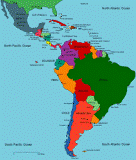 Welcome to the Carnival of Latin America and the Caribbean. If you would like your posts included, please email me, faustaw2 "at" gmail "dot" com.


 This photo is captioned,