Ethanol and wealth creation
In The Economist, an article about ethanol, Fuel for friendship
Firms around the world are trying to make biofuel out of everything from trees to cooking oil. To make ethanol from corn or wheat, as Americans and Europeans tend to do, distillers must first convert the starch in those crops into sugars. But Brazilian distillers dispense with this expensive step, as they use sugarcane as a feedstock. So Brazil can produce ethanol for 22 cents a litre, compared with 30 cents a litre for corn-based ethanol, according to Icone, a Brazilian think-tank. That makes it cheaper than petrol, and therefore lucrative for farmers without subsidies.U.S. sugar is too expensive to convert to fuel, thanks to a complicated system of tariffs and quotas that keeps the U.S. price of sugar artificially high, and the US can't produce enough sugar to meet an increasing demand in ethanol. Those are two reasons why import it.
However, as I mentioned in yesterday's Blog Talk Radio with WC of The Gathering Storm, the ethanol produced in Brazil is subject to a 54-cents-a-gallon US tarriff.
Since Brazil's ethanol has too much water (and is quite similar to rum), the way to get around this tarriff is for Brazil to ship its ethanol to dehidration factories in one of two dozen Caribbean countries that are exempt from the tarriff, and then take it to the US by tanker where a gasline refiner makes it undrinkable and blends it with gasoline. The blended ethanol is then shipped to gas stations.
The lobbyists and the politicians are to blame for this tarrif:
The ethanol industry not only receives billions of dollars in subsidies each year, but governmental protection from international competitors as well.But back to The Economist,
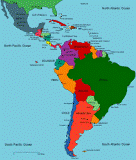
Brazil is not the only country in Latin America that sees great promise in ethanol. Colombia now has five distilleries amid the sugarcane fields of the Cauca Valley, which produce 360m litres a year. Two more are under construction elsewhere. These producers are guaranteed a market, since regulations oblige fuel merchants to mix ethanol into petrol. By 2009 the required blend will be 10% ethanol and will gradually rise to 25% thereafter. Costa Rica has a similar policy, and Panama is contemplating one.Secretary of State Condoleezza Rice and her Brazilian counterpart signed an energy agreement making ethanol an internationally traded commodity.
Indeed, since sugarcane is grown throughout the region, most Latin American countries could benefit. A recent study from the Inter-American Development Bank argued that replacing 10% of Mexico's petrol consumption with locally refined ethanol would save $2 billion a year and create 400,000 jobs. Several Caribbean governments hope that the ethanol boom could help revive their ailing sugarcane farms.
The greatest lure would be access to the American market. Various Central American, Caribbean and Andean countries can already send ethanol to America tariff-free, thanks to concessionary trade agreements. Maple, an American energy investment group, plans to spend $120m on an ethanol plant in Peru to take advantage of such a waiver. A pipeline running out into the nearby Pacific Ocean will deliver the plant's output directly to tankers bound for America. Proponents of the project say it will create 3,200 jobs. If all goes well, exports could reach 120m litres a year by 2010, and perhaps as much as 400m in the more distant future.
The United States, for its part, has several reasons to encourage ethanol production in Latin America. For one thing, it will need seven times more of the stuff than it currently produces to meet Mr Bush's 35 billion-gallon target. There simply is not enough spare land in America to grow adequate feedstock for such an amount, unless scientists find a way to make ethanol cheaply from abundant materials such as wood or grass. Although Mr Bush's ultimate goal is energy independence, he would presumably prefer to be dependent on ethanol from friendly countries such as Brazil and Colombia than on oil from hostile places like Iran and Venezuela.
An ethanol boom in Latin America would also attract investment to rural areas and create lots of jobs. That might help to reduce the steady northward stream of illegal immigrants. It would certainly burnish America's image, and stem support for anti-American tub-thumpers such as Venezuela's Hugo Chávez. He has won friends throughout the region by selling oil cheaply. By sharing technology and promoting investment in ethanol, America would also be reducing Latin America's fuel bill. If it bought lots of ethanol from its neighbours, it would be providing them with a lucrative export of their own.
This can be a first step that the US takes to unleash a new area of prosperity in Latin America. Let's create free markets, and create wealth by abolishing all farm subsidies and trade barriers with Latin American countries that are willing to provide property rights, democracy and the rule of law for their citizens.
President Bush went to Brazil and will also visit Uruguay, Colombia, Guatemala, and Mexico. Robert Mayer has more thoughts on the subject.
Update: Bush promotes trade with Uruguay
Uruguay is keen to sign free trade deals with the US, even if it means leaving the Mercosur trade bloc.
In yesterday's Blog Talk Radio show with WC of The Gathering Storm, I mentioned several books:
Journalists Plinio Apuleyo Mendoza, Carlos Alberto Montaner, and Alvaro V. Llosa's
Peruvian economist Hernando de Soto has written several books that I highly recommend on the subject of property rights, rule of law, capital creation and free markets:
Later in the conversation we talked about Dinesh D'Souza and Robert Spencer, who I met at CPAC last week. Their books are:
Dinesh D'Souza
and
Robert Spencer

Labels: books, Brazil, Colombia, economics, Economist, energy, environment, Guatemala, Latin America, Mexico, oil, politics, Uruguay, Venezuela
posted by Fausta @ 7:59 AM
0 comments